2. Networking concepts
1. Types of Networks
- LAN: Local connections; high-speed Ethernet or wireless.
- WAN: Links over large areas using fiber optics or satellites (e.g., internet).
2. Network Topologies
- Physical:
- Bus: Simple; single cable, prone to collisions.
- Star: Central switch; better performance.
- Mesh: Redundant connections; costly.
- Hybrid: Combines topologies (e.g., star-bus).
- VPC Topology: A virtual network on AWS offering isolation and configurability.
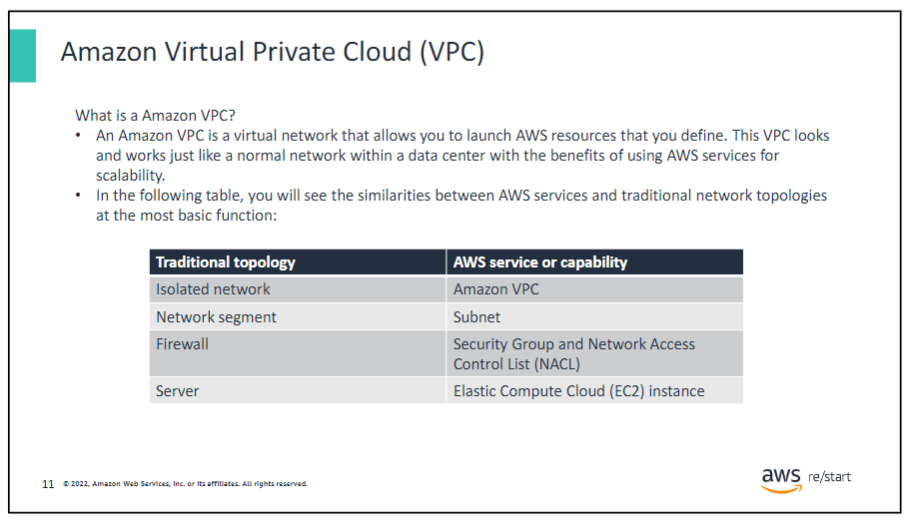
3. Amazon Virtual Private Cloud (VPC):
A VPC enables users to establish a private, virtual network on the AWS platform.12 It offers isolation and customisability, resembling a traditional network within a data centre
Comparison of LAN, WAN and VPC
| Feature | LAN | WAN | VPC |
|---|---|---|---|
| Definition | A network that connects devices in a limited geographical area, such as a floor, building or campus. | A network that connects devices over a large geographical area, such as multiple cities or countries. | A virtual network that allows users to launch AWS resources in a logically isolated space. |
| Geographical Span | Limited, typically within a single site. | Wide, spanning across cities, countries or continents. | Can span multiple regions within AWS, which are geographically dispersed. |
| Connectivity | Typically uses Ethernet cables or wireless technology. | Uses technologies like fibre-optic cables, satellites and leased lines. | Uses virtual networking constructs within the AWS cloud infrastructure. |
| Speed | Usually offers high data transfer rates due to shorter distances. | Can have varying speeds depending on the technology used; generally slower than LANs due to greater distances. | Can achieve high speeds within the AWS network, but inter-region communication might have higher latency. |
| Management | Usually managed by a single organisation. | Can be managed by multiple organisations or service providers. | Managed by the user within the AWS environment. |
| Cost | Relatively inexpensive to set up and maintain. | Can be expensive to set up and maintain due to the infrastructure required. | Costs depend on the resources used and configured within the VPC. |
| Examples | Home network, office network, school network. | The internet, corporate networks connecting multiple branches. | A virtual network for hosting web servers, databases and other applications within AWS. |
| Similarities to Traditional Network Concepts | Resembles a traditional LAN in terms of its limited scope and use of technologies like Ethernet. | Can be compared to a traditional WAN in its ability to connect geographically dispersed locations. | Shares similarities with traditional network concepts of isolation, segmentation and security through constructs like subnets and security groups. |
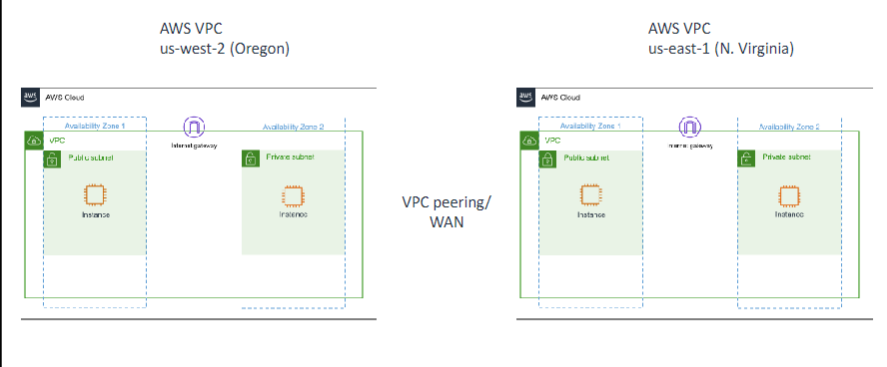
VPC Peering
VPC Peering allows private communication between two Amazon VPCs, enabling resource sharing. It connects VPCs across different AWS regions, similar to how a WAN links remote offices. Peering creates a private link, allowing traffic to flow directly between VPCs without going over the public internet. This method ensures secure, reliable connectivity between geographically dispersed networks in AWS.
4. Network Management Models:
- Client-Server Model: A central server manages and distributes data to clients; if the server fails, clients lose access.
- Peer-to-Peer Model: Each node manages its own data and resources; tasks are shared directly between peers without a central server. Security is less restrictive, and it’s suitable for small networks.
- This model might be considered under the following conditions:
- Users are responsible for backing up each node.
- Security requirements are not restrictive. • A limited number of peers are used.
Notebooklm summarization
Types of Computer Networks
- The two most common types of networks based on geographical span are Local Area Networks (LANs) and Wide Area Networks (WANs).
- A LAN connects devices in a limited geographical area, such as a floor, building, or campus. LANs commonly use the Ethernet standard for connecting devices and usually have a high data-transfer rate. Wireless technology is also commonly used for a LAN.
- A WAN connects devices in a large geographical area, such as multiple cities or countries. WANs use technologies such as fibre-optic cables and satellites to transmit data, and they connect LANs. The internet is considered to be the largest WAN.
| Feature | LAN | WAN |
|---|---|---|
| Geographical Span | Within the same building or floor | Can be geographically different locations, connected by a corporate WAN |
| Example | Office floor, building, or school | Two corporate offices across the United States connected by the internet |
Network Topologies
- A network topology is a pattern that shows how nodes connect to each other.
- There are two types of topologies: physical and logical.
- Physical topology refers to the physical layout of wires in the network.
- Logical topology refers to how data moves through the network.
- Examples of network topologies include Bus, Star, Mesh, and Hybrid.
Physical Topology: Refers to how devices are connected within a network.
Logical Topology: Refers to how data moves through a network.
- Bus topology: Positions all devices along a single cable. It runs in a single direction and is simple to configure, however, it only allows one computer to send a signal at a time, which can cause network collisions.
- Star topology: Every node is directly connected to one central switch using coaxial, twisted-pair, or fibre-optic cables. Data sent from any node must pass through the central switch to reach its destination.
- Mesh topology: A complex structure where nodes are interconnected. There are two types of mesh topologies:
- Partial mesh: All devices are connected to at least two other devices.
- Full mesh: All nodes are interconnected. A full-mesh topology provides full redundancy but is expensive. It is most likely found in a WAN.
- Hybrid topology: Combines two or more topology structures. The star-bus topology is the most common hybrid topology and is often used in large organisations.
Logical Topologies
- Bus, Star, Mesh, and Hybrid topologies all have logical portions.
- A VPC (Virtual Private Cloud) is a virtual network that allows you to launch AWS resources that you define. An Amazon VPC is an example of a logical topology, and it functions similarly to a normal network within a data centre.
- The logical topology of a bus network also follows the route of the cable, moving in one direction.
- In a star topology the central switch manages data transmission.
Network Management Models
- A network management model defines the roles and relationships of the devices in a network.
- The two most common models for LAN are client-server and peer-to-peer.
Network Management Model: A representation of how data is managed, and how applications are hosted in a network.
- Client-server model: Data management and application hosting are centralised at the server and distributed to the clients. All clients must use the designated server to access shared files and information.
- If the server goes down, no client can access the network.
- Peer-to-peer model: Each node has its own data and applications and is responsible for its own management and security.
- Peers are equally privileged participants in the architecture, and files can be shared directly between systems without a central server.
- This model may be considered when users are responsible for backing up each node, security requirements are not restrictive, and a limited number of peers are used.
Network Protocols
- A network protocol defines the rules for formatting and transmitting data between devices on a network. It operates at layer 3 (Network) and layer 4 (Transport) of the OSI model.
- Network protocols fall into two categories: connection-oriented and connectionless.
Network Protocol: A set of rules for formatting and transmitting data between devices on a network.
- Connection-oriented protocol: Establishes a connection, waits for a response, creates a session between sender and receiver, and uses synchronous communication. It ensures that a connection is established, and checks if the message was received.
- Connectionless protocol: Sends a message without ensuring that the destination is available and ready to receive the data. It does not require a session between sender and receiver and uses asynchronous communication. This protocol is faster than a connection-oriented protocol, and it does not care if a session is established.
Examples of Network Protocols:
- Internet Protocol (IP): Establishes the rules for relaying and routing data on the internet.
- Transmission Control Protocol (TCP): Provides a reliable, connection-oriented, and ordered delivery of bitstreams over an IP network. TCP is great for transferring important files since there is a guarantee of connection.
- TCP uses a three-message handshake to establish connection, which consists of Synchronize (SYN), Synchronize/Acknowledge (SYN/ACK), and Acknowledge (ACK) messages.
- User Datagram Protocol (UDP): Uses a simple connectionless communication model to deliver data over an IP network. It is unreliable because it does not guarantee the delivery or ordering of data. UDP is faster than TCP and is used for media streaming.
Comparison of TCP and UDP
| Feature | TCP | UDP |
|---|---|---|
| Connection | Connection-oriented | Connectionless |
| Reliability | Reliable | Unreliable |
| Data Delivery | Guaranteed and ordered | Not guaranteed or ordered |
| Overhead | Larger | Lower |
| Speed | Slower | Faster |
| Handshake | 3-step handshake | No handshake |
| Use Case | File transfer | Media streaming |
Key Takeaways
- A local-area network (LAN) connects devices in a limited geographical area, and a wide-area network (WAN) connects devices in a large geographical area.
- A network management model defines how data is managed, and how applications are hosted in a network. Client-server and peer-to-peer are two common network management models for a LAN.
- A network topology shows how nodes connect to each other. Star and hybrid are example patterns of a network typology.
- A VPC is a virtual network that allows you to launch AWS resources that you define. A VPC looks and works just like a normal network within a data centre with the benefits of using AWS services for scalability.
- A network protocol defines the rules for formatting and transmitting data between devices on a network.